
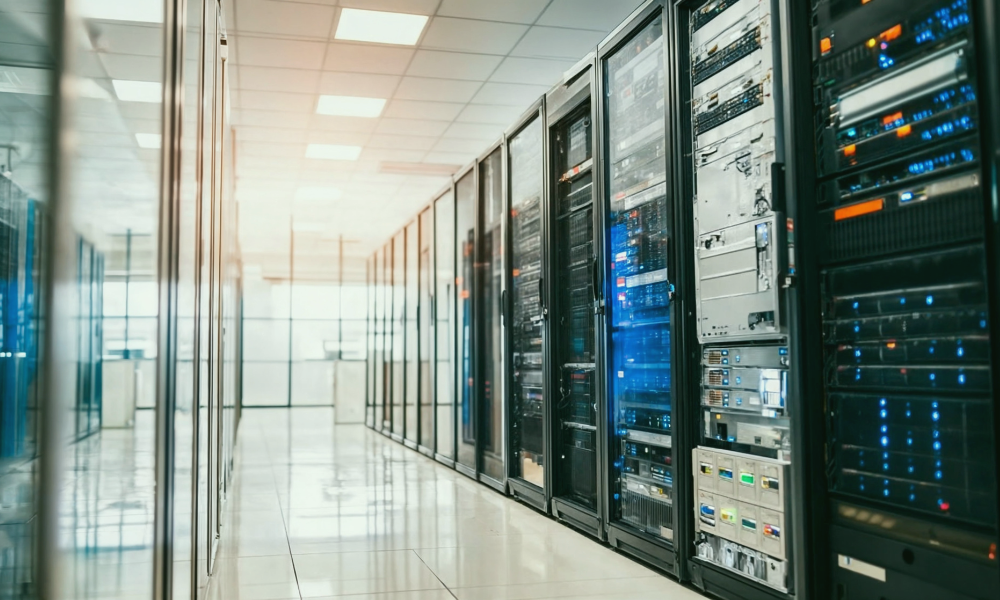
Data centers are facilities built for the purpose of handling and directing high volumes of digital information and electronic data traffic. These facilities are equipped with equipment that powers, stores, processes, and transfers data. As functions that require massive levels of power and data, such as cryptocurrency and artificial intelligence, have become increasingly popular over the last several years, the need for facilities that can handle these requirements has increased as well. According to the United Nations Environment Programme, the number of data centers around the globe has increased from 500,000 in 2012, to 8 million in 2024.
Are you concerned about data centers? Let your state legislators know! This link will take you to a pre-written email, but please customize to fit your concerns.
Missouri Coalition for the Environment believes data centers, just as other industries, should be regulated to protect people and their environment. You can learn more about our policy recommendations below.
Environmental Impacts
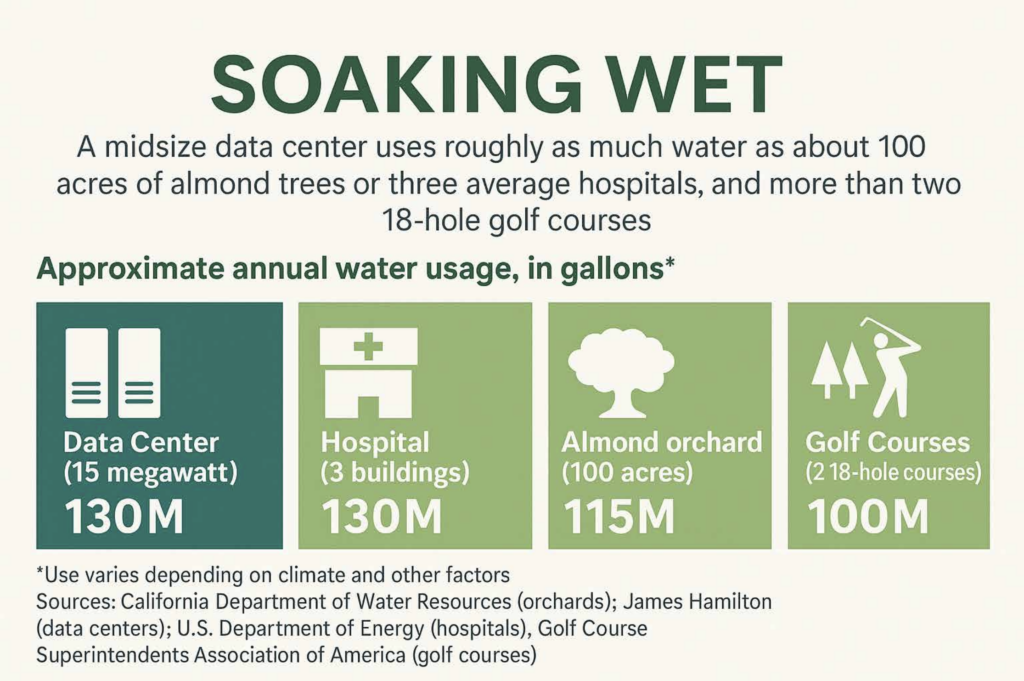
Data centers are incredibly water intensive. Water is used directly to cool onsite equipment and indirectly through energy consumption.
- Large data centers can consume over 5 million gallons of water per day. (1)
- Water used by data centers is mostly evaporated, which means they will concentrate existing pollutants, such as PFAS, nitrates, and heavy metals, in the water they discharge back into our watershed. (2)
- Yañez-Barnuevo, Miguel. “Data Centers and Water Consumption,” Environmental and Energy Study Institute, June 25, 2025.
- Cooper, Sean Patrick. “How Oregon’s Data Center Boom Is Supercharging a Water Crisis,” Rolling Stone, November 24, 2025. https://www.rollingstone.com/culture/culture-features/data-center-water-pollution-amazon-oregon-1235466613/
Data centers are hot, noisy nuisances. They run 24/7, creating non-stop heat, noise, and light pollution, which disrupts human health.
- Internal noise levels in data centers reach up to 96 decibels, which can cause permanent hearing loss after just 30 minutes of exposure. (1)
- Constant noise exposure affects sleep, increases stress, and damages cardiovascular health. (2)
- Light pollution from constant security lighting can disrupt sleep and is linked to breast cancer and negative effects on mental and cardiovascular health. (3)
- Data centers generate so much heat that their excess is being used to warm thousands of homes in Finland, Sweden, and the UK. (4)
- Heat is already deadliest weather event in the country, claiming over 1,200 lives each summer. (5)
- Nationwide, data centers are expected to increase healthcare costs by $5.6 billion. (6)
- American Speech-Language-Hearing Association. “Loud Noise Dangers.” ASHA – Hearing & Balance. Accessed September 15, 2025.
- Araújo Alves, Juliana et al. “Low-Frequency Noise and Its Main Effects on Human Health,” Journal of Applied Scientists, July 28, 2020. https://www.mdpi.com/2076-3417/10/15/5205.
- Cho, Y., et al. “Effects of artificial light at night on human health: A review of the literature.” Environmental Research, 2015.
- North, Madeline. “Here’s how data centre heat can warm your home,” World Economic Forum, June 18, 2025.
https://www.weforum.org/stories/2025/06/sustainable-data-centre-heating/. - Adams-Fuller, Terri. “Extreme Heat Is Deadlier Than Hurricanes, Floods and Tornadoes Combined,” Scientific American, July 1, 2023. https://www.scientificamerican.com/article/extreme-heat-is-deadlier-than-hurricanes-floods-and-tornadoes-combined/
- Han et al. “The Unpaid Toll: Quantifying the Public Health Impact of AI,” Cornell University arixiv, December, 2024.
Like any digital technology, data center equipment has a limited lifespan. E-waste from data centers is expected to reach 5 million tons by 2030, which will need to be safely reused or recycled. (1)
- Missourians have already suffered from improper e-waste recycling of lithium ion batteries, which caused an explosion resulting in evacuations, a fish kill, and respiratory problems. (2)
- Improperly handled e-waste can release up to 1,000 different chemical substances, causing stillbirth, damaging neurodevelopment, and exacerbating respiratory illness. (3)
- Wang, Peng et al. “E-waste challenges of generative artificial intelligence,” Nature Computational Science no. 4 pp. 818–823, October 28, 2024. https://www.nature.com/articles/s43588-024-00712-6.
- Kite, Allison. “After battery plant fire, southeast Missouri town alarmed about potential contamination,” Missouri Independent, February 17, 2025. https://missouriindependent.com/2025/02/17/after-battery-plant-fire-southeast-missouri-town-alarmed-about-potential-contamination/.
- World Health Organization. “Electronic Waste Key Facts,” October 1, 2024. https://www.who.int/news-room/fact-sheets/detail/electronic-waste-%28e-waste%29.
Massive amounts of energy are needed to power data centers. Ameren intends to build gas and nuclear generation to meet data center demand, which will increase data center water needs. Increased use of fossil fuels, like natural gas, will continue to accelerate droughts, floods, and severe storms across the state.
- One large data center can use over 100 MW of electricity, or the equivalent of 16,400 homes. (1)
- Electricity rates skyrocket for homes near data centers, rising up to 20%. (2)
- Homes near data centers are at higher risk for electricity outages: In 2022, Texas data centers caused 112 MW of outages. (3)
- Data centers mostly use fossil fuels to power their massive energy needs. (4)
- Roe, Don. “Data Centers—Land Use, Environmental, and Economic Consideration,” City of St. Louis Planning & Urban Design Agency, September 8, 2025. https://efis.psc.mo.gov/Document/Display/849169
- Halper, Evan and Caroline O’Donovan. “As data centers for AI strain the power grid, bills rise for everyday customers,” The Washington Post, November 1, 2024.
- McLaughlin, Tim. “Big Tech’s data center boom poses new risk to US grid operators,” Reuters, March 19, 2025.
https://www.reuters.com/technology/big-techs-data-center-boom-poses-new-risk-us-grid-operators-2025-03-19/ - Marinoni, Andrea, et al. “The data heat island effect: quantifying the impact of AI data centers in a warming world” https://arxiv.org/abs/2603.20897

Policy Recommendations
- Require publicly disclosed environmental impact assessment + mitigation plan, including water use, electricity use, noise levels, heat island study, e-waste recycling
- Closed loop water cooling systems required
- Electricity needs met with 100% clean, renewable sources
- Strict limits on diesel-fired backup testing, use
- Require advance community approval for all data center building + expansion projects
- No by right zoning approval for data centers
- Ban use of NDAs
- Public disclosure of data centers’ purpose
- Reject proposals that have applied for state and/or local tax abatements
- Repeal state and local tax abatements for data centers
- No rate increases for residential customers
- Renewable energy paid for upfront to match or exceed needed additional grid capacity
- Upfront payment to a green infrastructure fund
- Community input guiding benefit agreements
- Require payouts for unrealized tax benefits
Resources
- MCE: Data Center Policy Recommendations (below)
- MCE: Environmental Impacts of Data Centers (below)
- Environmental Protection Network: Data Center Resource Directory
- AI Now: Site Fight Guide
- Ohio Environmental Council: Playbook for Communities Facing Large Scale Development
- MCE: Data Center Scorecard (below)